How Global Furniture Group Got 29 Minutes Back on Every Order
7,200 orders. 6 million SKUs. One very relieved customer service team.
5 min read
Somewhere in Global Furniture Group's inbox is a purchase order for a walnut lounge chair with a brass base. Simple enough, right? Except Global has more than 6 million SKUs. The dealer's description doesn't necessarily match what's in the catalog. There's a specific finish, a specific base, and a price tied to that customer's account. And someone has to figure all of that out before entering a single line into the ERP. Now multiply that by thousands of orders.
For years, this was everyday life for Global's 23 customer service reps across five branches. They were good at their jobs. They knew the products, knew their customers, and knew their way around the company's IBM AS/400. But even the best reps can only move so fast when every order means reading, interpreting, matching, checking, and manually entering information.
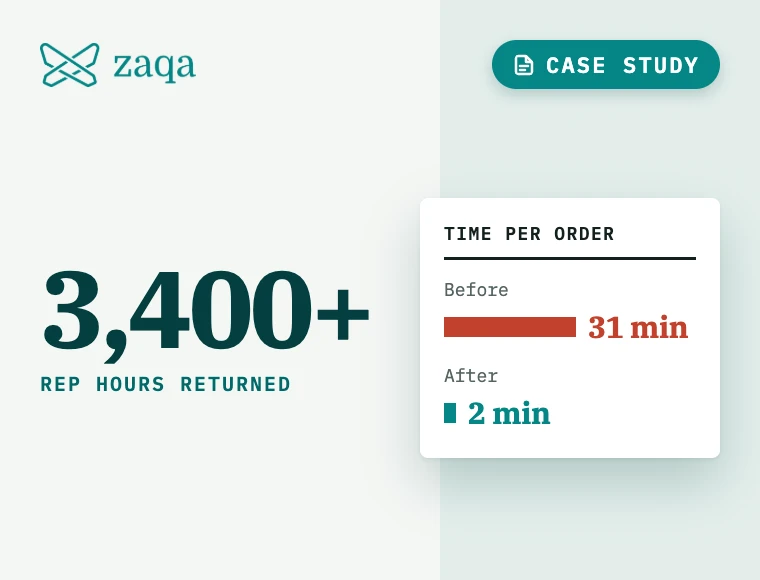
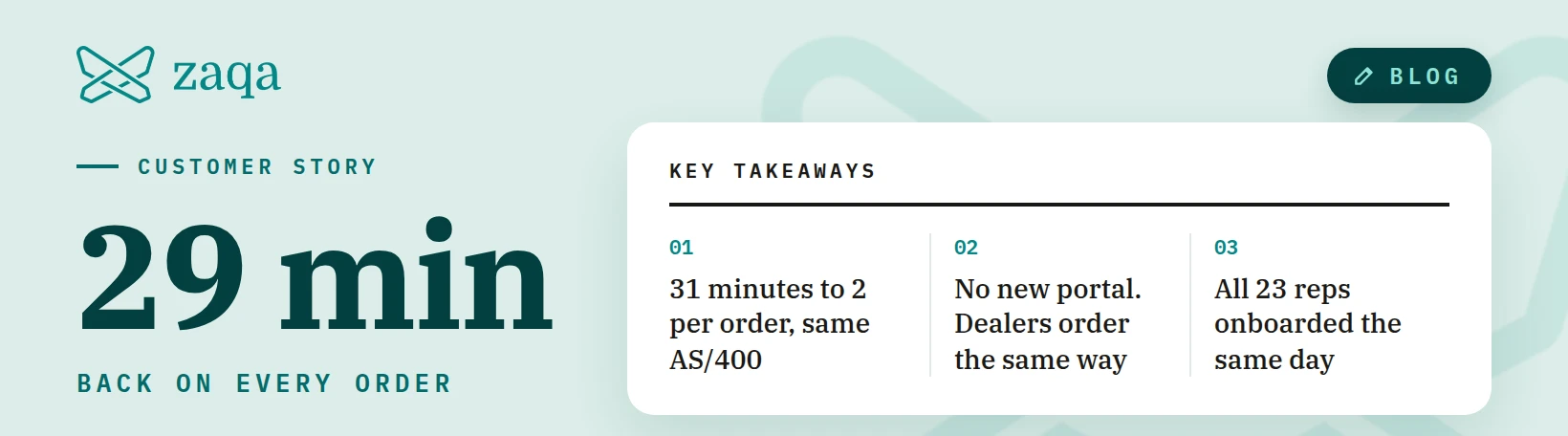
On average, that took 31 minutes per order. Today, it takes about two. Here's what changed.
Six million SKUs. And someone has to find the right one.
The thing about purchase orders is that customers rarely send them exactly the way your systems would like. Some arrive as PDFs. Others come through email, dealer forms, or drawings. Some have everything neatly laid out. Others require a little detective work. Global's team dealt with all of it.
And with a catalog of more than six million SKUs, the difficult part wasn't just entering the information. It was knowing what to enter. A veteran rep might recognize a dealer's shorthand immediately. Someone newer might need to spend more time searching, comparing configurations, and double-checking the details.
That knowledge is incredibly valuable. But there's a difference between having experienced people make decisions and having them spend hours manually entering the results of those decisions. Nobody gets into the furniture business dreaming of memorizing SKUs. Yet across manufacturing and distribution, that's exactly where some of the most knowledgeable people spend a surprising amount of their day.
Global didn't need a new ERP. It needed to give its people a break.
Global runs on an IBM AS/400. If you've worked in manufacturing or distribution long enough, you probably know the type. It's been around, it gets the job done, and replacing it isn't exactly a casual Tuesday project. And why should Global have to replace a system that works just to eliminate manual order entry?
The same goes for its dealers. They already had ways of submitting orders. Asking every customer to learn a new portal or change their purchasing process wasn't the answer. So instead of changing everything around the order, Global changed what happened to the order once it arrived.
Zaqa reads incoming POs, whether they're PDFs, emails, forms, or drawings. It uses Global's own catalog and customer logic to identify the correct products and build the order. A rep reviews it, makes sure everything looks right, and approves it. One click later, the order is in the AS/400.
The green screen stays. The retyping goes. No ERP migration. No new dealer portal. No asking customers to change how they buy. Just a lot less work between receiving an order and getting it into the system.
The numbers are impressive. The adoption might be even better.
New software is one thing. Getting an entire team to actually use it is another, especially when you're asking experienced reps to change a process they've been doing successfully for years.
But Global wasn't asking its team to abandon the systems and knowledge they already relied on. Zaqa fit into their existing order-entry process, with reps still reviewing and approving orders before they reached the ERP. All 23 reps were onboarded the same day. And according to Jason Koerner, Global's Head of Customer Service:
"The adoption of Zaqa was the easiest we've seen — easier than the adoption of our own CRM by the same team."
That's a pretty meaningful compliment from someone responsible for the people doing the work every day. Because the best automation isn't necessarily the one with the most features. It's the one your team actually wants to use.
So, what does 29 minutes back per order actually look like?
In Global's first 90 days using Zaqa:
| Metric | Result |
|---|---|
| Orders processed | 7,200 |
| Line items processed | 26,000 |
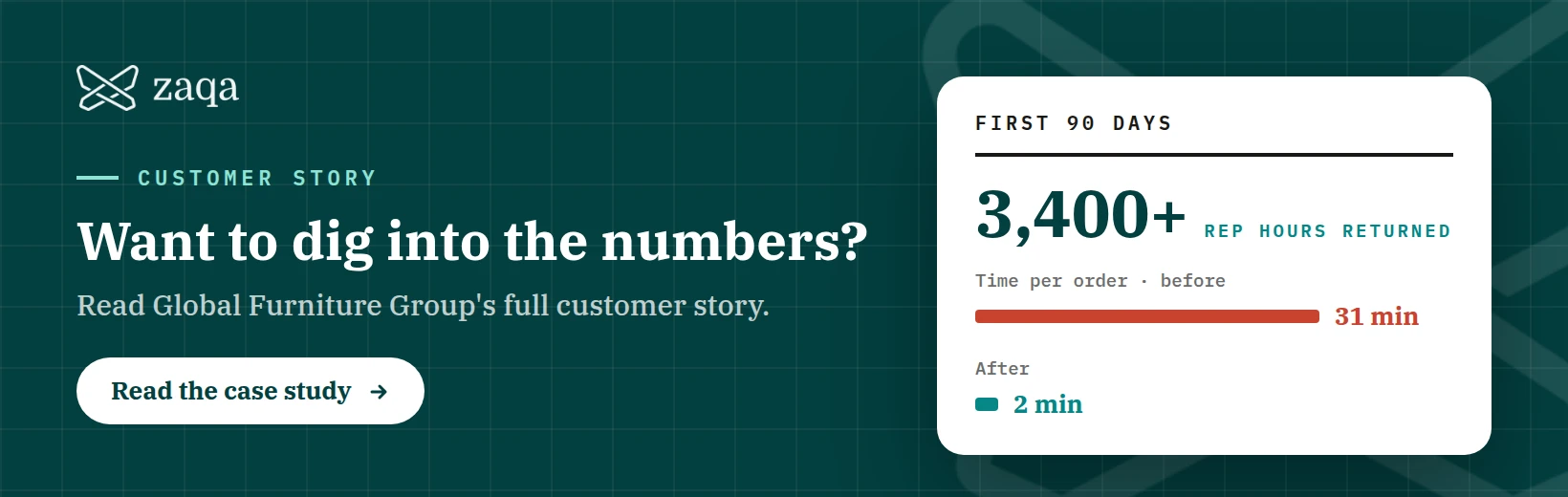
| Hands-on work per order | 31 minutes → 2 minutes |
| Reduction in active work | 93.2% |
| Rep hours returned | 3,400+ |
| Labor value returned | $250,000 |
| Annualized capacity returned | 10,000+ hours |
Let's put that into perspective. That's thousands of hours Global's team no longer has to spend manually processing purchase orders: time that can go toward helping dealers, answering questions, resolving issues, and handling the work that actually needs an experienced person.
And as order volume grows, that recovered capacity becomes even more valuable. Because more orders should be good news. They shouldn't automatically mean more people sitting at keyboards. As Global's COO, Ari Asher, put it:
"Zaqa solved a problem we've had for years, giving back hours per day to every rep. The solution is pretty impressive."
Your best people have better things to do than enter POs.
Here's what makes Global's story interesting: its problem wasn't unique to furniture. Maybe your catalog doesn't have six million SKUs. Maybe your customers order electrical components, lumber, doors, or building materials instead of office furniture. But if your team spends its day opening PDFs, deciphering customer descriptions, searching for part numbers, and entering orders into an ERP, you know the feeling.
The work has to get done. The question is whether your people have to keep doing all of it manually. Global found a way to give its team that time back without changing the systems that run its business or the way its customers order.
Same customers. Same ERP. Twenty-nine minutes less manual work per order. And that's time worth getting back.
How much time is hiding in your order-entry process?
Global was spending 31 minutes per order before Zaqa. What does that number look like for your team?
Calculate what manual order entry is costing you →
- order entry
- ERP automation
- furniture
- customer story